Story contentsbrevity bard.
Mystery4 min read

Agnes

Your place is saved on this device.

CHAPTER 5

Chapter 5 – Red Lace and Old Sins

The funeral committee insisted on a white-and-gold colour code, but Amaka wore red.

Amaka wears a crimson lace dress among funeral guests dressed in white and gold.
Red among white and gold

Deep crimson lace with subtle black embroidery. Not loud, but pointed. When she stepped out of the mansion and into the marquee set for the final farewell, the air shifted. Murmurs flitted across the crowd.

White-and-gold funeral guests turn and whisper as Amaka enters in crimson.
Whispers at her arrival

“She wore red?” “Tradition forbids it.” “Is it defiance or grief?”

Funeral guests whisper in shock at Amaka's crimson dress.
Defiance or grief

Amaka walked past them all like royalty. The sun gleamed on the pearls she still wore, now matched with bloodstone earrings. Her steps were measured, calm. Not sorrowful. Just... resolved.

Amaka walks past the funeral guests in crimson lace and pearls.
She moves through the mourners with calm resolve.

Chuka trailed behind her, dressed in regulation white agbada, sunglasses hiding the lines of confusion on his face. Uju arrived separately, and stood at the back, observing.

Chuka follows Amaka at the funeral while Uju observes from the back.
Chuka trails behind, his uncertainty hidden by sunglasses.

On the altar sat the casket—polished mahogany, framed with yellow roses. A blown-up photo of Agnes towered behind it: the carefully curated public image. The soft smile. The eyes that held a nation spellbound.
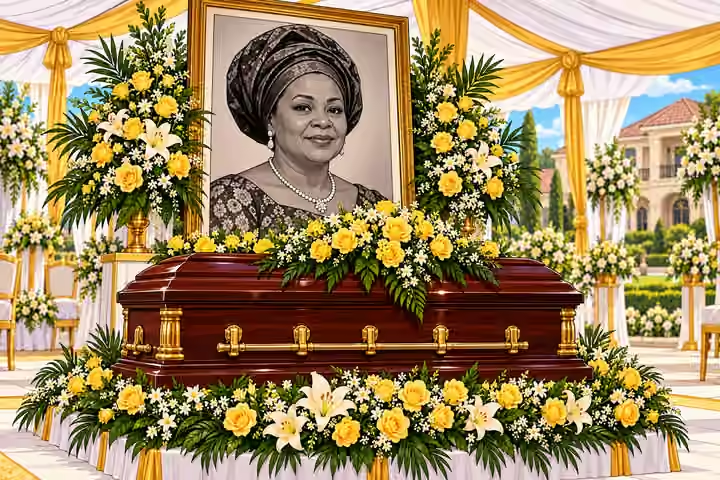
Agnes’s mahogany casket stands beneath her memorial portrait.
Yellow roses frame the carefully composed farewell.

Pastor Gabriel took the pulpit.

Pastor Gabriel takes the pulpit at Agnes’s funeral.
He prepares to lead the tribute.

"Today, we bury a woman of virtue," he began, hands raised like a prophet. "A mother to the motherless, a warrior of faith, a generous spirit..."

Gabriel praises Agnes from the funeral pulpit.
His raised hands give the tribute a theatrical force.

Amaka tuned him out.

Amaka tunes out Gabriel’s tribute.
She withdraws behind a composed expression.

She stared at his hands—those same hands that signed off fake building fund accounts, collected hush money from Agnes, laundered funds through 'missions’ in Uyo and Accra. He was still trying to survive her death, pretending they hadn't both used each other.

Amaka studies Gabriel’s hands as he speaks.
She listens with suspicion instead of admiration.

Her fingers curled around the program in her lap. One more performance.

Amaka’s fingers tighten around the funeral program.
Her frustration shows in a small movement.

Detective Musa watched from the side of the marquee, not as an invited guest, but as a quiet observer. His suit was plain. No badge. No notebook.

Musa observes the funeral from the side of the marquee.
He watches quietly without presenting himself as a guest.

His eyes scanned the room.

Musa scans the mourners gathered under the marquee.
He searches their faces for signs of tension.

Chief Bamidele—stone-faced, leaning on a cane. Nneka—tight-lipped, seated in the front row, barely concealing disdain. Pastor Gabriel—sweating more than usual. Ngozi—the ex-maid, sitting at the back in cheap white lace, watching everyone with a smirk. Uju—motionless, clutching a plain white clutch bag like a weapon.

Musa notices tension among five mourners at the funeral.
Bamidele, Nneka, Gabriel, Ngozi and Uju each reveal unease.

Too many motives. Too many layers.

Musa considers the competing motives around him.
The mourners offer no simple answer.

And one daughter in red.

Musa’s attention settles on the daughter dressed in red.
Amaka stands apart from the white-and-gold crowd.

After the service, mourners lined up to offer condolences.

Mourners line up to offer Amaka their condolences.
The service gives way to personal farewells.

Amaka received them with grace: a hand on the shoulder, a bowed head, a soft “Thank you.” She didn’t flinch at the strangers who wept or at the politicians who used her mother's name for clout.

Amaka receives a mourner with a bowed head and a hand on her shoulder.
She accepts condolences with controlled grace.

It wasn’t until Pastor Gabriel approached that something flickered in her eyes.

Amaka’s expression changes as Gabriel approaches.
His presence breaks the smooth rhythm of condolences.

"My dear child," he began, voice thick with performance. "She was proud of you. She told me so. Many times."

Gabriel tells Amaka that Agnes was proud of her.
His sympathetic manner feels practiced.

Amaka held his gaze. “She told many people many things. You should be careful who believes them.”

Amaka answers Gabriel with a pointed warning.
She holds his gaze without softening.

His smile froze for half a second. Then he nodded and moved on.

Gabriel’s smile freezes before he nods and moves on.
Amaka’s reply unsettles him.

Uju came next.

Uju approaches Amaka after Gabriel leaves.
The next visitor brings a different tension.

“I almost didn’t come,” she said quietly.

Uju quietly admits that she almost stayed away.
Her arrival was not an easy decision.

“But you did.”

Amaka notes that Uju came despite her hesitation.
Her reply is measured.

“I needed to see it. The show.”

Uju calls the funeral a show.
She studies the ceremony with skepticism.

“Did it live up to your expectations?”

Amaka asks whether the funeral met Uju’s expectations.
Her composure gives the question an edge.

Uju studied her. “I don’t know what to expect from you anymore.”

Uju studies Amaka and admits she no longer knows what to expect.
Uncertainty replaces the formal condolences.

“Then we’re even,” Amaka said, and turned away.

Amaka turns away after her final reply to Uju.
The exchange ends with distance between them.

That evening, Musa returned to his office to find a brown parcel on his desk. No name. No return address.

Musa discovers an anonymous brown parcel on his desk.
A new delivery waits at the office.

Inside was a USB drive and a single page typed in Courier font.

The parcel contains a USB drive and a single typed page.
The anonymous package holds two items.

“Agnes wasn’t poisoned by a stranger. Follow the girl in red.”

Musa reads the anonymous instruction to follow the girl in red.
The message directs suspicion toward someone close.

He plugged in the drive.

Musa plugs the USB drive into his computer.
He opens the evidence left for him.

Security footage—unedited, date-stamped.

Security footage begins playing on Musa’s monitor.
The drive contains an unedited recording.

Kitchen corridor. Wedding day. 2:12 p.m.

The recording shows the kitchen corridor on the wedding afternoon.
The camera establishes the place and time.

A waiter in white approaches a woman in a veil. Not Amaka. But the build is close. Face obscured.

A waiter approaches a veiled woman in the security footage.
The woman resembles Amaka in build but keeps her face hidden.

The waiter hands over a tray with a single flute of champagne. The woman dips a vial into the glass—quick, precise—and stirs with the base of a spoon. She wipes it clean and disappears through a service door.

The veiled woman discreetly adds liquid to the champagne.
The recording captures the tampering in the corridor.

Musa paused. Rewound. Watched again.

Musa pauses and rewinds the recording to watch it again.
He studies the crucial moment repeatedly.

Not Amaka.

Musa doubts that the veiled woman is Amaka.
The recording challenges his first assumption.

But someone dressed very, very deliberately.

Musa studies the veiled woman’s deliberate disguise.
The clothing appears carefully chosen.

He ran the footage through facial enhancement software. The face never shows. The veil does all the work. But there was one clear frame—when she opens the door and walks past a mirror.

Musa enhances a frame of the woman passing a mirror.
A reflection offers the first small clue.

A partial reflection.

A partial reflection appears in the corridor mirror.
The veil still conceals most of the woman’s identity.

Hair. Shoulder. Jawline.

Musa focuses on the reflected hair, shoulder and jawline.
Only fragments of the woman can be seen.

It wasn’t Amaka.

Musa again concludes that the figure is not clearly Amaka.
The image refuses to settle the question.

But it also wasn’t not her.

Musa remains troubled by the resemblance.
Certainty slips away as he studies the evidence.

At the estate, Amaka sat on the rooftop balcony overlooking the water. A half-empty glass of wine balanced on the edge of the railing. Chuka stood a few feet away, uncertain whether to step closer.

Chuka hesitates a few feet from Amaka on the rooftop balcony.
She watches the water while he weighs whether to approach.

“You don’t sleep anymore,” he said finally.

Chuka tells Amaka that she no longer sleeps.
His concern breaks the quiet on the balcony.

“Sleep is for the at-peace.”

Amaka says sleep belongs to people who are at peace.
She keeps her gaze on the water.

“And you’re not?”

Chuka asks whether Amaka is at peace.
He searches for a more personal answer.

“Not yet.”

Amaka says she is not at peace yet.
Her answer leaves the night unsettled.

He moved closer. “You were brilliant today.”

Chuka moves closer and praises Amaka’s composure at the funeral.
He tries to offer reassurance.

“Of course I was.”

Amaka accepts Chuka’s praise as a matter of course.
Her confidence remains intact.

“But you scared me. In red.”

Chuka admits that Amaka’s red outfit frightened him.
Her deliberate choice unsettled him.

“That was the point.”

Amaka explains that unsettling people was intentional.
Her reply confirms his unease.

Chuka swallowed hard. “Did you… love her?”

Chuka asks whether Amaka loved her mother.
He struggles to voice the question.

Amaka’s silence stretched.

Amaka lets Chuka’s question hang in silence.
Neither moves as the pause lengthens.

“I loved what she could have been. I loved the version of her I kept inventing to survive her.”

Amaka describes loving the mother she wished Agnes could have been.
She speaks of the version she imagined to endure their relationship.

Chuka didn’t reply.

Chuka has no reply to Amaka’s admission.
He listens in silence.

She turned to him.

Amaka turns toward Chuka.
Her attention shifts directly to him.

“If you ever ask me that again,” she said softly, “I’ll answer differently. And you won’t like it.”

Amaka warns Chuka against asking that question again.
Her soft voice carries an unmistakable boundary.

Detective Musa sat at his desk past midnight.

Musa remains at his desk after midnight.
He keeps working while the office is dark.

He now had motive, means, and opportunity—but the wrong suspect. Or maybe, the perfect one.

Musa weighs evidence that may point to the wrong suspect.
Motive and opportunity have not brought certainty.

Amaka had been cold. Controlled. Composed.

Musa reflects on Amaka’s controlled composure.
Her restraint complicates his judgment.

But never careless.

Musa recognizes that Amaka has never been careless.
He questions whether the obvious evidence fits her.

That footage had been sent to him on purpose.

Musa realizes the footage was delivered deliberately.
He examines the anonymous parcel again.

And the girl in red?

Musa considers the message about the girl in red.
The anonymous instruction continues to trouble him.

Maybe she wanted to be followed.

Musa wonders whether Amaka wanted to be followed.
He considers whether the lead was an invitation.

Or maybe she was setting the next trap.

Musa wonders whether the evidence is another trap.
Suspicion follows him into the end of the night.
There’s more to the story.
Read the original blog post ↗