Story contentsbrevity bard.
Mystery5 min read

Agnes

Your place is saved on this device.

CHAPTER 4

Chapter 4 – The Other Side of the Mirror

Two days after the funeral was announced, the internet crowned Amaka Emecheta “the face of dignified grief.” Her poised media interviews were clipped into TikToks. Her tear-streaked photo, taken just minutes after Agnes’s death, trended with hashtags like #DaughterOfSteel and #JusticeForAgnes. Newspapers called her the “solemnest bride Nigeria ever saw.”

Amaka gives a tearful but composed interview while microphones and a phone frame her face.
The face of dignified grief

Inside the Emecheta estate, however, things weren’t quite as picturesque.
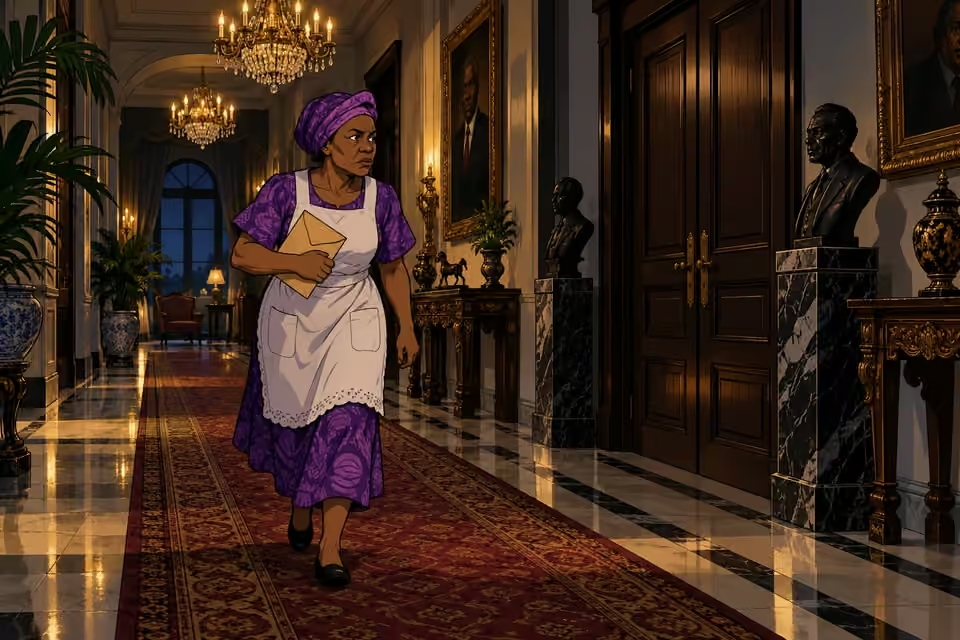
Mama Tutu hurries through the mansion's shadowed corridor holding an envelope.
Behind the polished facade

The housekeeper, Mama Tutu, walked briskly down the corridor toward the late Agnes’s study, a brown envelope clutched tightly in her hand. “I don’t want trouble,” she muttered, “but these Lagos people play too many games.”

Mama Tutu grips a brown envelope while approaching the study anxiously.
The envelope she carried

She knocked once, twice. No answer.

Mama Tutu knocks on the closed study door, clutching an envelope.
Two knocks receive no answer.

She opened the door.

Mama Tutu opens Agnes’s study door with an envelope in hand.
She enters the dim study.

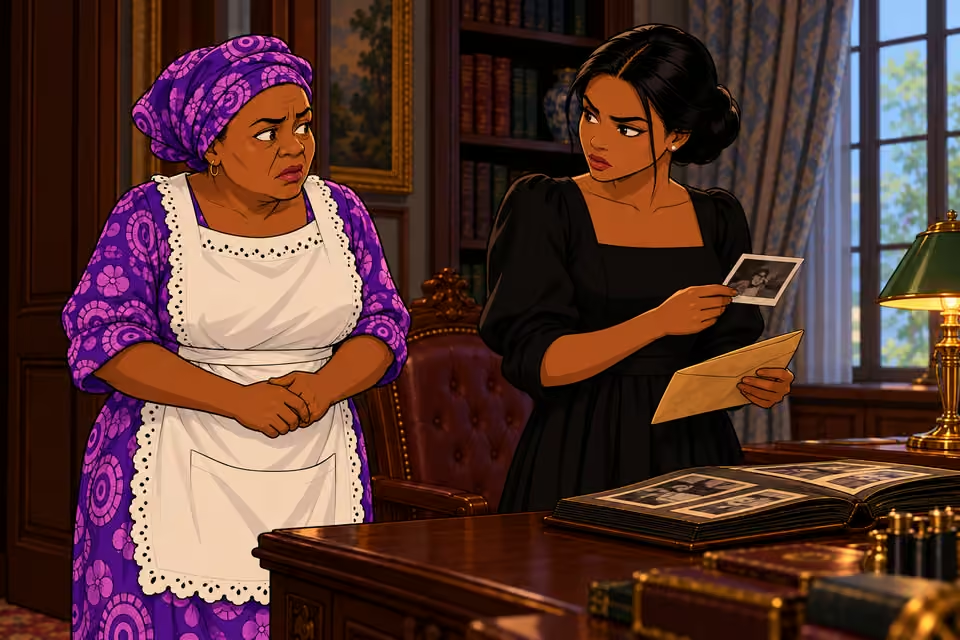
The room was dim. Curtains half-drawn. Amaka stood before her mother’s antique desk, flipping through an old photo album. She didn’t look up.

Amaka stands at the desk and turns an album page.
She keeps her attention on the album as Tutu enters.

“You have something?”

Amaka asks Tutu whether she has brought something.
Her eyes remain on the album.

“Yes, madam.” Tutu stepped forward, offered the envelope. “Someone sent it this morning. No name. No note. Just this.”
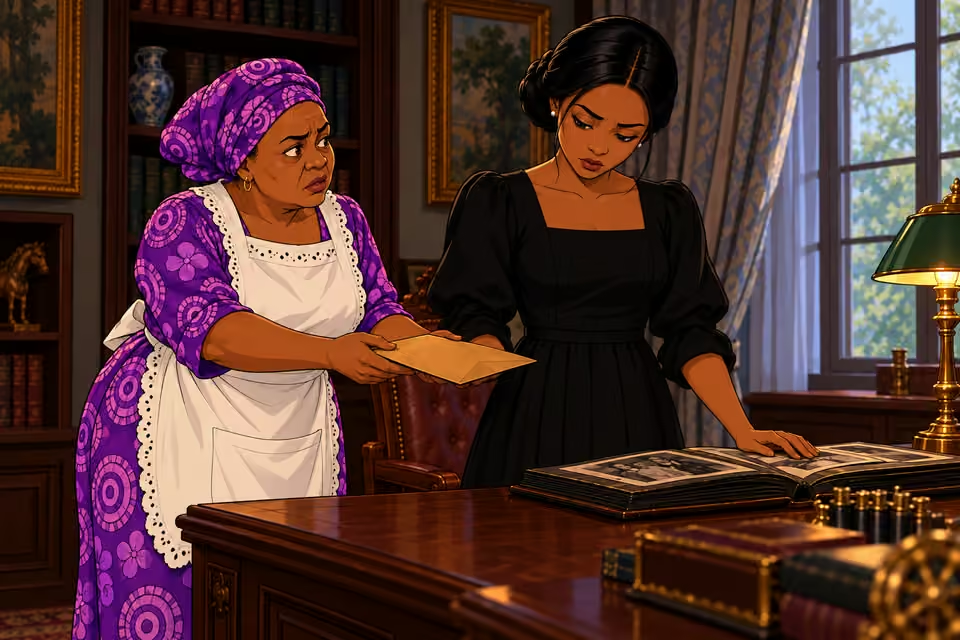
Mama Tutu offers Amaka an anonymous brown envelope.
The delivery carries no explanation.

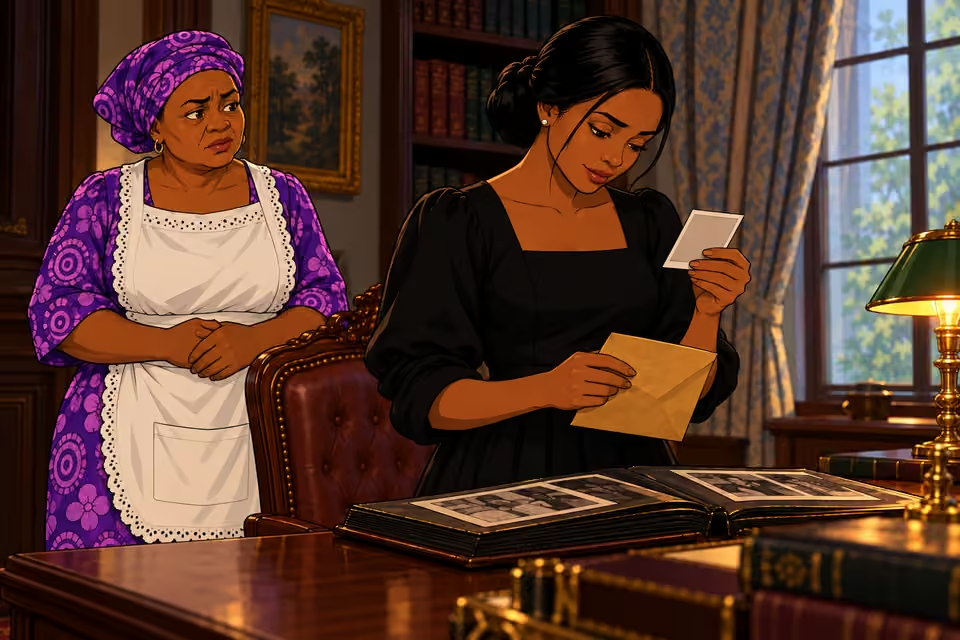
Amaka took it without flinching, peeled it open. Inside was a memory card and a single Polaroid photograph of Agnes… with Pastor Gabriel. They were in the back of a car. She was holding a large brown envelope. He was looking away. The timestamp in the corner read 12 March 2024.

Amaka opens the envelope and finds a memory card and a revealing photograph.
The photograph links Agnes and Pastor Gabriel.

Amaka’s lips pressed into a line.

Amaka presses her lips together after seeing the contents.
She controls her reaction to the discovery.

“You’ve seen this?”

Amaka asks whether Tutu has seen the photograph.
She checks how far the secret has travelled.

“No, madam.”

Tutu says she has not seen the contents.
The housekeeper answers carefully.

“Good.”

Amaka accepts Tutu’s answer with a single measured response.
She is satisfied that the contents stayed private.

She slid the photo back into the envelope and tucked the memory card into her pocket. “Thank you.”

Amaka returns the photograph to its envelope and pockets the memory card.
She keeps the evidence close.

Mama Tutu lingered. “There’s more, you know.”
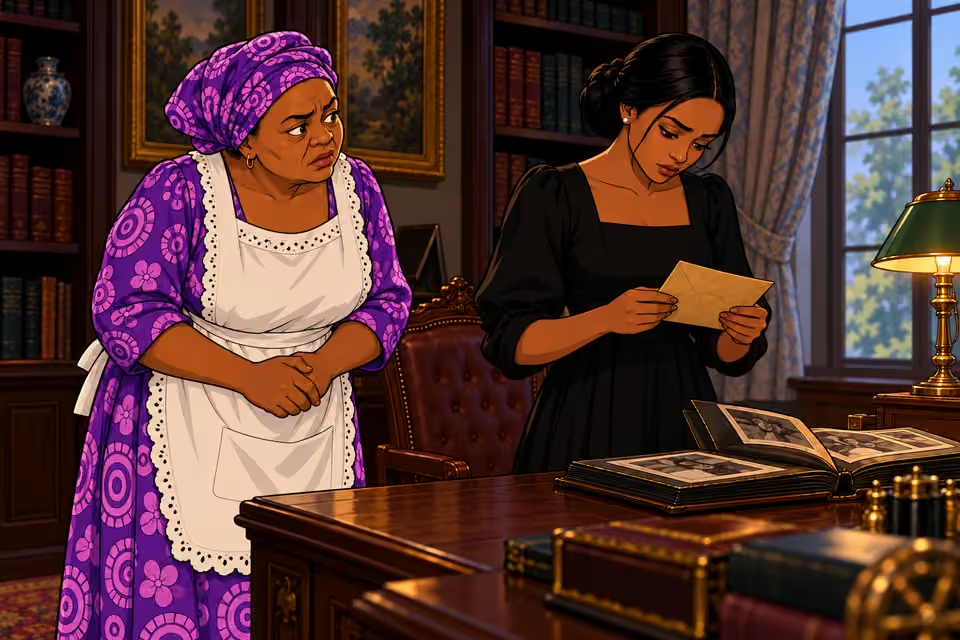
Mama Tutu lingers and hints at further secrets.
She still has something to say.

Amaka finally looked up. “More what?”

Amaka looks up and asks what else Tutu knows.
Her full attention shifts to the housekeeper.

“Your mother’s secrets. You were protected. Others weren’t.”

Tutu says Agnes protected Amaka while others suffered.
Her warning reveals a harsher side of the household.

“She protected me the way lions protect meat. With teeth.”
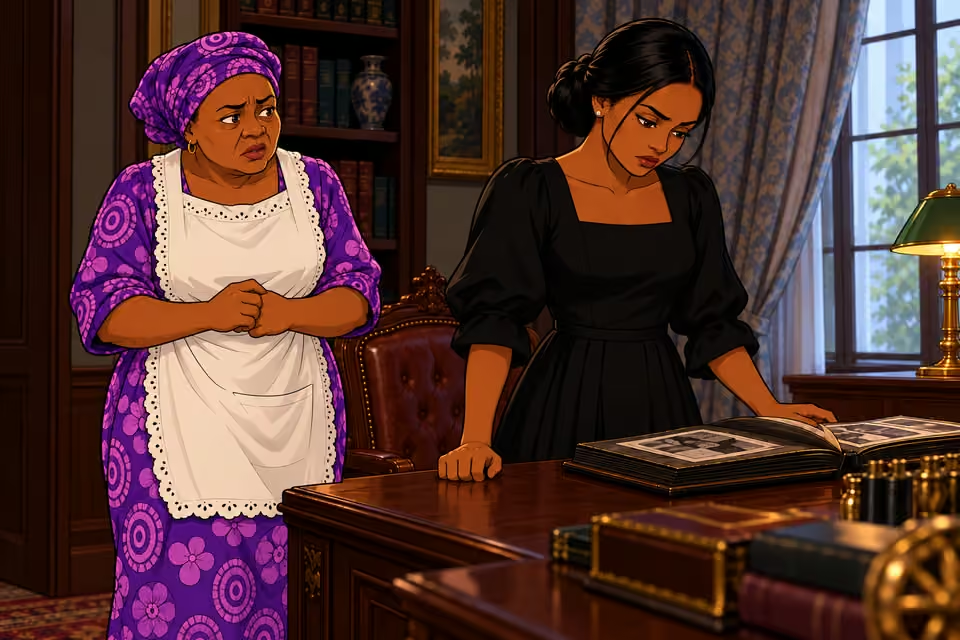
Amaka describes her mother’s protection as possessive and cruel.
Her answer carries years of resentment.

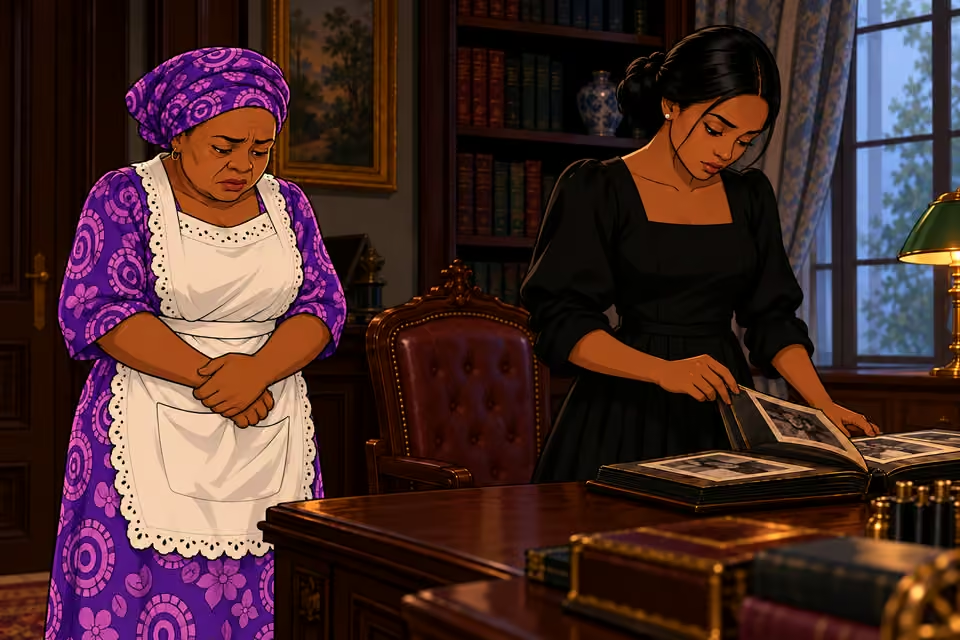
Mama Tutu said nothing.

Mama Tutu falls silent after Amaka’s bitter reply.
She offers no answer.

Amaka gave her a small nod. “Lock the door behind you.”

Amaka dismisses Tutu and asks her to lock the door.
She wants the study left private.

Across town, Pastor Gabriel stood at the pulpit of his Ajah church, preaching a sermon on humility to a sea of well-dressed congregants. His words rang with conviction, but his eyes were on the last row—where two plainclothes officers stood, arms folded, listening too closely.

Pastor Gabriel notices two officers watching from the church’s last row.
His sermon continues under quiet scrutiny.

After the service, one of them approached the pastor quietly.

An officer approaches Pastor Gabriel after the service.
The conversation begins discreetly.

“You’ve been summoned to the station tomorrow morning, sir.”

The officer summons Gabriel to the station the next morning.
The request is polite and firm.

Gabriel tried to remain calm. “About?”

Gabriel asks what the summons concerns.
His composure takes effort.

“Your financial dealings with the late Agnes Emecheta.”

The officer names Gabriel’s financial dealings with Agnes.
The investigation reaches the pastor’s accounts.

A smile twitched at his lips. “As I’ve said before, Madam was a generous donor. Nothing more.”

Gabriel calls Agnes a generous donor and nothing more.
His reassuring smile is strained.

“Then it’ll be a short visit.”

The officer suggests Gabriel’s visit should be brief.
The reassurance carries a quiet challenge.

Detective Musa sat in his office with the audio tech, headphones plugged in, eyes fixed on a waveform recording from the Emecheta estate’s backup drive—recovered from the central security server. It was audio only, but it captured what the corrupted camera footage could not: a conversation between two women in the bridal suite the morning of the wedding.

Musa and the audio technician listen to a recovered recording.
The estate’s backup drive supplies an audio lead.

Agnes: “Fix your face, Amaka. You’re getting married, not attending a funeral.” Amaka: “Hard to smile when you’re threatening my future.” Agnes: “Threats are for people who have choices. You don’t.” Amaka: “Chuka isn’t your business anymore.” Agnes: “Everything you are is my business.” [silence] Agnes: “Don’t let me regret raising you.” Amaka: “You didn’t raise me. You built me. Like one of your charities.”

Musa listens as the recording reveals a tense exchange between mother and daughter.
The recorded words expose the strain in their relationship.

Musa leaned back. The tone wasn’t warm. But it wasn’t murderous either.

Musa leans back and weighs the tone of the recording.
The hostility is clear, but its meaning remains uncertain.

Still, it was something.

Musa recognizes the recording as a useful lead.
The conversation gives him something to pursue.

He reached for his phone.

Musa reaches for his phone after reviewing the recording.
He moves to follow the new lead.

That evening, Amaka met with the family lawyer, Mr. Akinwale, in her father’s old library.

Amaka meets Mr. Akinwale in her father’s library.
They begin discussing the estate.

“The estate needs an executor,” he said. “She didn’t sign the amended will. Which means…”

Akinwale explains that Agnes never signed the amended will.
The estate needs an executor.

“I get everything,” Amaka finished.

Amaka concludes that she inherits everything.
She understands the consequence immediately.

He nodded. “Unless someone contests.”

Akinwale warns that someone could contest the estate.
His agreement carries a qualification.

“No one will.”

Amaka insists that no one will contest the estate.
She leaves little room for doubt.

“There’s the matter of her offshore accounts. Seychelles, Malta, Dubai—”

Akinwale raises the matter of Agnes’s offshore accounts.
The estate’s finances reach beyond Nigeria.

“Shut them down. Anything tied to Pastor Gabriel should be scrubbed. Quietly.”

Amaka orders the accounts linked to Gabriel closed quietly.
Her decision is immediate and forceful.

He looked at her carefully. “Are you sure you want this handled so… aggressively?”

Akinwale questions how aggressively Amaka wants the accounts handled.
Her instructions make him pause.

Amaka smiled. “My mother played chess. I play poker. I know when to fold her hand.”

Amaka smiles as she explains her own approach to her mother’s affairs.
She intends to make the next decision herself.

Detective Musa arrived at the station the next morning and found a letter waiting on his desk.

Musa finds an anonymous letter on his office desk.
A letter waits for him at the station.

Typed. Anonymous. No signature.

Musa examines the unsigned typed letter.
The sender leaves no name or signature.

“Ask Gabriel who deposited N42 million in his building fund three days before the wedding. Ask him where the cook is. Ask why his name appears on an account opened in Uyo under a fake Emecheta Foundation. The truth is not in the pulpit.”

Musa reads the letter’s accusations about Gabriel’s finances.
The anonymous message points toward the pastor.

Attached was a copy of a transaction slip.

A transaction slip is attached to the anonymous letter.
The accusation arrives with a piece of paper evidence.

Musa narrowed his eyes. Too neat. Too fast.

Musa narrows his eyes at the conveniently timed evidence.
The lead seems suspiciously neat.

It was a plant. Someone wanted the case solved—wrong.

Musa suspects the letter is meant to mislead the investigation.
He recognizes an attempt to steer the case.

At the Emecheta estate, Chuka found Amaka in the garden again, pacing.

Chuka finds Amaka pacing in the estate garden.
He approaches her with a worry of his own.

“I’m being watched,” he said.

Chuka tells Amaka that he feels watched.
His unease interrupts her pacing.

She looked up. “By who?”

Amaka looks up and asks who is watching Chuka.
Her question is direct.

“Detectives. Reporters. Your family. My family. I don’t know.”

Chuka struggles to identify who is watching him.
His suspicions reach in every direction.

“You should be careful, then.”

Amaka tells Chuka to be careful.
Her answer offers little reassurance.

He stepped closer. “Are we okay?”

Chuka steps closer and asks whether they are all right.
His worry turns toward their marriage.

“We’re fine,” she said, voice flat.

Amaka gives Chuka a flat reassurance.
Her tone leaves the tension intact.

“I mean… you’re scaring me, Amaka. You don’t grieve. You calculate.”

Chuka says that Amaka’s calculating composure frightens him.
He asks for an emotional response he cannot see.

She turned fully toward him. “My mother’s body isn’t even buried, and you’re worried about how I’m grieving?”

Amaka turns toward Chuka and challenges his concern about her grief.
Her answer becomes confrontational.

“I’m worried about what you’re hiding.”

Chuka admits he is worried about what Amaka is hiding.
He names the doubt between them.

She stepped in close, looked him dead in the eyes.

Amaka steps close and meets Chuka’s eyes.
Her gaze demands his full attention.

“You married a woman who survived Agnes Emecheta. Don’t expect roses and rainbows.”

Amaka reminds Chuka that she survived life with Agnes.
She warns him not to expect easy reassurance.

He stepped back.

Chuka steps back from Amaka.
Her words create distance between them.

“You’re not the same,” he said quietly.

Chuka quietly says that Amaka has changed.
He studies the distance between them.

“No,” she replied. “I’m better.”

Amaka answers that she is better now.
She accepts the change with conviction.

That night, Amaka sat alone in Agnes’s study. The room still smelled of her perfume—oud, lavender, and something acidic underneath. She lit a candle, opened the safe, and pulled out a small black journal.

Amaka retrieves a small black journal from the safe at night.
Alone in the study, she begins to examine it.

Inside were names.

Amaka studies the names listed inside the black journal.
The pages begin with a private list.

Transactions.

Amaka examines transaction entries in the journal.
The book records more than names.

Secrets.

Amaka absorbs the secrets recorded in the journal.
The private pages hold her attention.

And beneath the last page, a note, handwritten in her mother’s delicate cursive:

Amaka finds a handwritten note beneath the journal’s last page.
A final message has been tucked away.

“They’ll never see you coming. Just like I didn’t.”

Amaka reads her mother’s final handwritten message.
The note acknowledges a surprise Agnes never foresaw.

Amaka read it twice. Then smiled.

Amaka rereads the note and smiles.
Its meaning brings a private satisfaction.

She whispered into the dark:

Amaka whispers into the dark study.
Her response is meant for no one else.

“Good.”

Amaka gives a quiet word of approval.
Her whispered response closes the night.
There’s more to the story.
Read the original blog post ↗